- service@nationaldetectives.in
- +91 8800462341

AI Tools for Smart and Easy Fraud Detection in Future
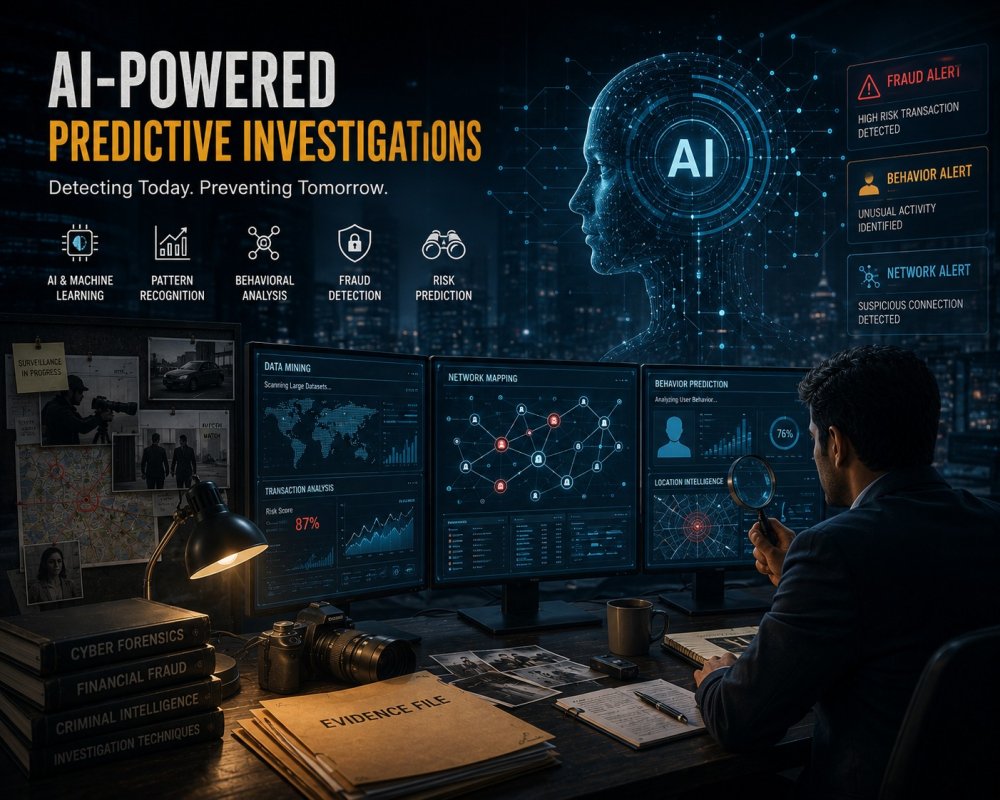
AI (artificial intelligence) is revolutionizing investigations across sectors in an ever more data-driven world. From financial fraud and cybercrime to organized rackets, predictive investigations facilitated by AI have revolutionized investigative practices from reactive inquiries into proactive ones that use artificial intelligence (AI). Instead of waiting until crimes occur before trying to trace culprits later, professionals now utilize AI for early warning and disruption of illegal activities ahead of time - thus changing how professional investigators and detectives approach investigations altogether. This article delves into how artificial intelligence (AI) is revolutionizing investigative practices, with special reference to how private investigators and detectives in India are adopting this revolutionary tech to stay abreast of fraudsters and organized criminals.
Understanding Predictive Investigations
Private investigator Using AI and involve using data, behavioral analysis, machine learning and pattern recognition techniques proactively in order to anticipate crimes or fraud before they take place. Their aim is not just faster resolution of cases but preventing new ones altogether - in traditional investigations actions follow an incident; AI-powered approaches take preventive steps before incidents escalate further.
Key areas where predictive investigations have proven their worth
Financial and banking fraud and theft, insurance scams, cybercrime and phishing attacks, retail theft organized retail theft electoral manipulation identity fraud as well as crime hotspots
Modern Investigations now utilize AI as part of their toolbox for investigation
1. Data Mining and Pattern Recognition
AI systems can scour through vast amounts of structured and unstructured data quickly, quickly recognizing irregularities which humans would miss, such as repetitive transactions, shell accounts or discrepancies in user behavior that human investigators might miss. In an auditing investigation for financial fraud cases for instance, AI would likely spot patterns like repetitive transactions, shell accounts or inconsistencies with user behaviors as part of its analysis process.
2. Behavioral Modeling
AI can analyze past actions to predict future behavior, creating risk profiles using factors like frequency, timing, transaction size and interaction channels - an indispensable technique in cases involving insider fraud, organized crime or employee misconduct.
3. Natural Language Processing (NLP)
AI can analyze social media posts, emails, customer service complaints or chat logs using Natural Language Processing to detect threats such as hate speech and planned fraud schemes. Private investigators utilize NLP analysis tools in monitoring online threats or relationship disputes or blackmail cases.
4. Link Analysis and Network Mapping
AI can create visual maps showing connections among suspects, accounts, locations and events to quickly uncover racketeering activities or conspiratorial schemes in India - making life simpler for detectives in their attempts at uncovering real estate fraud or matrimonial scams.
5. Facial Recognition and Biometrics
AI systems have long been utilized by law enforcement and licensed private detectives alike as an invaluable tool in tracking individuals through facial recognition, iris scans, gait patterns, voiceprints or voiceprint analysis. Law enforcement uses these tools in their search efforts for criminal suspects or missing people as they track down any fugitives from justice who evade detection, stalkers or unknown squatters who escape capture or simply go missing altogether.
6. Using Location Data to Predict Crime
AI can be used to analyze crime locations and the time when crimes usually happen. This helps in understanding which areas may have a higher risk of crime.
This kind of information helps police and private security teams identify such areas early so they can strengthen security there in advance.
Application in Fraud and Organized Activity Detection
1. Banking and Financial Sector
AI tools have proven valuable in detecting anomalous transactions like account takeovers, money laundering operations or synthetic identities. With predictive analytics tools at their fingertips auditors and investigators can focus on high-risk cases faster and cheaper - helping reduce time and costs to achieve optimal efficiency in auditing operations and investigations.
2. Fraud in Insurance and Healthcare
In insurance and healthcare departments, artificial intelligence is now used to detect fraud. AI analyzes customer details and third-party vendor information to help identify suspicious cases.
Insurance detectives also use AI tools during investigations to check false medical claims. This helps detect fraud more quickly and easily.
3. Cybercrime
Its Predictive algorithms help anticipate phishing campaigns, data breaches and malware attacks by analyzing behavior across networks. Cybercrime investigators use AI technology to detect botnets or fake e-commerce websites.
4. Retail and E-Commerce
AI can use customer behavior analysis, refund requests and delivery patterns to detect refund fraud schemes such as internal theft or reseller manipulation. Detective Agency In India working at large platforms often employ AI dashboards for monitoring suspicious sellers or affiliate fraudsters.
5. Electoral and Identity Fraud
AI-powered identity verification, document analysis, and voter roll scanning tools have become effective tools in India's electoral fraud investigation efforts in high stakes elections to detect any false registrations or illegal deletions of registered voters.
Indian Private Investigators Leveraging AI for Investigative Work
India's private investigation landscape is rapidly shifting. While traditionally dependent upon surveillance, manual verification, and local intelligence sources for their investigations, modern private detectives in India are turning increasingly towards AI-powered tools that expand their abilities.
1. Matrimonial and Background Checks
AI tools are increasingly being deployed to provide accurate background checks on prospective marriage partners or criminal defendants in India. Detectives use traditional fieldwork along with AI to validate income claims, marital statuses or criminal histories compiled online profiles or court databases and financial details that allow accurate background investigations to take place.
2. Missing Persons and Digital Trails
In missing person cases, AI can help law enforcement during investigations. AI analyzes data like mobile tower pings, social media activity, and travel bookings to find possible leads that may help trace the person.
AI-based facial recognition software is also used. It can scan CCTV footage from different places and help identify the missing person.
3. Corporate Employee Monitoring
AI can use email logs, system access patterns and digital footprint analysis to detect data leakage or corporate spying activities; private detectives use AI technology for internal HR investigations as well.
4. Asset Tracing and Forensic Accounting
Machine learning models scour asset flows, corporate records and tax data in order to detect hidden assets such as shell companies or benami holdings.
AI-Driven Investigations Have Their Share of Challenges
•AI is a strong tool but it also has some problems. When people collect and study data they must follow privacy laws and basic ethical rules. If the data is used in the wrong way, it can create legal problem
•Sometimes AI can make mistakes. It may show an innocent person or company as suspicious and because of this unnecessary investigation needed.
•Also, if the data given to AI is incomplete or wrong the results are also wrong. That is why human checking is important.
Collaboration Between Tech and Field
AI should complement, rather than replace human expertise for maximum impact. Human expertise such as intuition, local knowledge and ethical judgment cannot be replaced by AI alone - while billions of data points may pass through AI systems at lightning speeds it still takes someone with understanding context, motive and emotion to put things into context and understand nuances like context motive and emotion.
Investigative agencies have evolved in response to technological change by merging.
AI tools and traditional investigation methods are used together now. For example, AI dashboards are checked along with manual surveillance. Predictive analytics is compared with eyewitness interviews and their statements. Digital forensics is also verified with normal documents and records. Sometimes investigators also get real-time alerts and understand the situation.
Conclusions of Investigations Are Hybrid
AI-powered predictive investigations mark an unprecedented shift in how crime and fraud is addressed. Private investigators in India use these powerful tools with unmatched reach, efficiency and foresight - however this technology will only ever be as good as its users!
Private investigators in Delhi represent the future - professionals who combine intuition with innovation, street smarts with software. Crime has evolved and investigations must adapt as well. Protecting corporate assets, uncovering fraudsters or upholding justice are among the many roles detectives will be expected to fulfil their next-generation colleagues must not only seek clues but anticipate them.