- service@nationaldetectives.in
- +91 8800462341

Corporate Data Leaks: Can a Private Detective Identify the Source
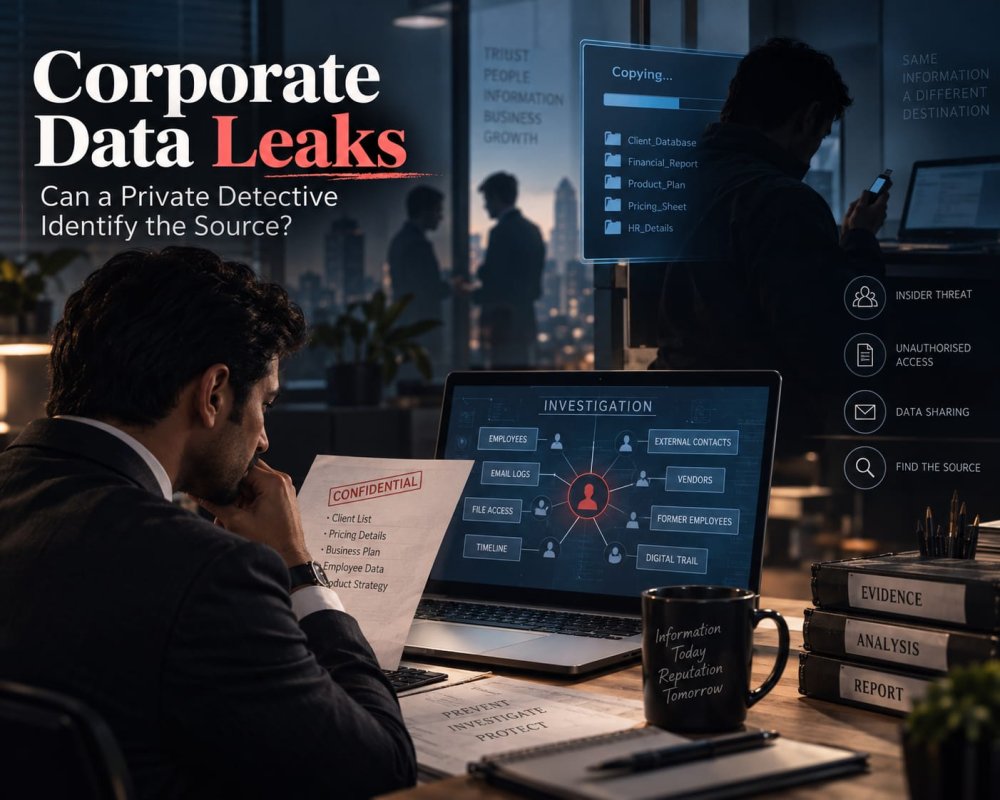
A company finds out that some private information has gone outside the office. It could be a customer list, company file, price details or an upcoming business plan. The difficult part is finding out who shared it and where the information went.
Sometimes the leak is noticed only after the information reaches another person or even a competitor. The company has a few doubts but without proof it is hard to know the truth. A private detective can check the available information, speak to the people connected with the case and follow the available clues to find the source of the leak.
What Is a Corporate Data Leak
A corporate data leak happens when private company information gets into the hands of someone who should not have it.
Some common examples include:
• Confidential documents being shared outside the company
• Customer information being sent to an unauthorised person
• Company files being copied before an employee leaves
• Internal business plans reaching a competitor
• Private emails or messages being forwarded
• Product or pricing information being shared early
• Employee or client databases being misused
• Photos or screenshots of confidential documents being circulated
The source is not always an employee. A third party vendor, former employee, business partner or another person with access to company information also be involved.
Can a Private Detective Find the Source
Yes, a detective can try to find the source of a company data leak. The investigation starts with the information already available.
The detective check:
• Employees who had access to the file
• People who handled the documents
• Emails or messages related to the file
• The time the information was shared
• People outside the company who received it
For example if only five employees had a confidential file and the same file later reached a competitor those five employees can be checked during the investigation.
Checking File Access
The company has many employees but a confidential file is usually seen by a limited number of people. Their access can be checked during the investigation.
The detective check:
• Employees who could open the file
• Staff members who handled the document
• Departments that had the information
• Former employees who still had access
• Outside people who received the details
• Vendors or business partners who had the information
Having access does not mean that the person leaked the information. It gives the investigator some clues to check.
Employee and Former Employee Involvement
Employees can sometimes have access to sensitive company information as part of their work. A leak may happen during employment or after an employee leaves the company.
A private detective may check facts around the employee's activities, contacts and movements within the limits of the law.
Former employees can also become relevant if confidential files were copied or taken before leaving the organisation.
The investigation may focus on the period before and after the information was leaked rather than making assumptions about a person from the beginning.
Digital Information Can Provide Clues
Many corporate leaks leave some form of digital trail. However, access to company systems and private accounts must be handled legally.
Depending on the case, a company may already have useful records such as:
• Email records
• File access logs
• Login records
• Download records
• Device activity
• Document sharing records
• CCTV footage
• Internal communication records
A Digital Forensic Investigation is important when technical records or electronic devices need closer examination. A private detective work with the company's IT team or digital forensic professionals where technical examination is required.
A detective should not simply break into someone's email, phone or social media account to find information. Investigation work has to stay within the law.
Finding the Person Who Received the Information
Sometimes the source is easier to understand by looking at where the leaked information went.
For example, a competitor may suddenly have a company's internal pricing sheet. A third-party contact may receive a document that was never meant to leave the company.
Investigators can examine available information and connections between the company, employees, former employees, vendors, customers and outside contacts.
Open source information is also important in some cases. Public websites, social media activity, business records and other publicly available information may provide links that help connect different parts of the case.
Why the Timing Matters
The timing of a leak can provide an important clue. For example if a company changes its prices and a competitor gets the details soon after the people who knew about the new prices can be checked.
The same approach can be used for:
• New product information
• Tender documents
• Client lists
• Salary information
• Business expansion plans
• Merger or acquisition details
Looking at the timeline can help investigators understand where the information may have moved.
Finding the Source Is Not Always Easy
Sometimes there is not enough information to find the person behind a data leak.
A file has been shared with several people, an old password has been used, or the information has come through a vendor or another outside system.
In some cases, the company does not even know exactly which information was taken.
Even then an investigation can help clear some doubts and give the company a clear idea of where the leak has started.
What a Company Should Do After a Leak
A company should act quickly after discovering a possible leak.
Useful steps include:
• Preserve existing records and documents
• Restrict unnecessary access to sensitive files
• Record the date and time of the discovery
• Identify the information that may have leaked
• Keep copies of relevant emails and other records
• Make a list of people who had access
• Avoid deleting or changing important evidence
• Take legal advice where required
A private detective can then work with the available information and investigate the possible source.
Kerala Data Leak Case
A recent case from Kochi, Kerala shows the importance of internal access in a data leak investigation.
Sensitive KMRL information was reportedly shared outside the organisation. The investigation also checked if someone from inside the company was involved.
The case included:
• Company documents
• Financial information
• Employee details
• Possible internal access
These types of cases show the reason for checking file access, employee records and digital information during a corporate data leak investigation. These types of cases also require private investigation in Kerala, Bangalore, Delhi or any other city to find the source of the leaked information.
Conclusion
Corporate data leaks can come from different sources, and finding the person behind a leak is not always simple. A private detective can examine people, access, timelines, public information and other available evidence to find useful links.
The investigation should be based on facts rather than assumptions. Companies should also make sure that any investigation is carried out legally and that important evidence is preserved from the beginning.